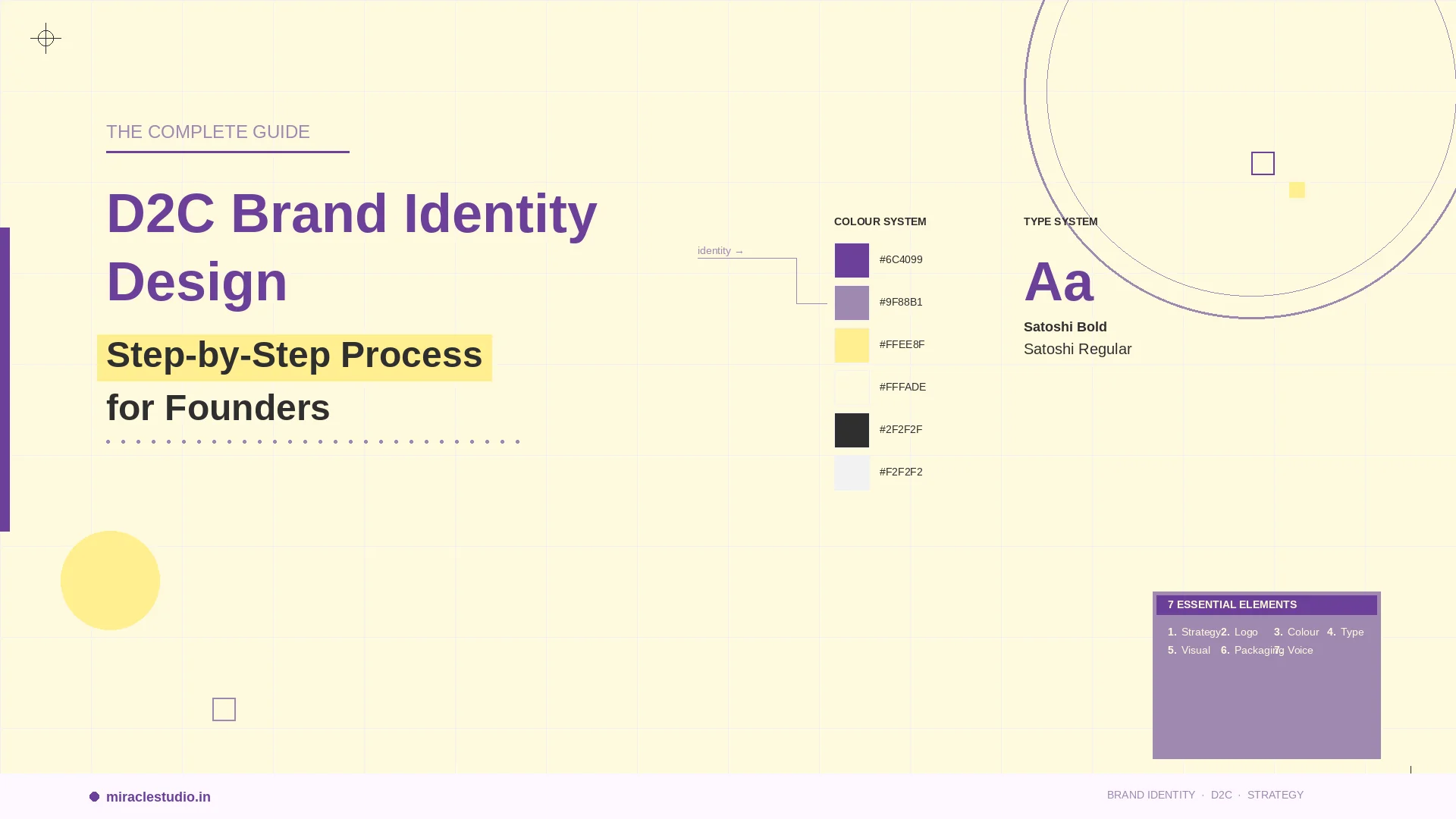
TL;DR: Brand identity design for D2C brands is a strategic system — not a logo exercise. This guide covers the complete process: positioning, visual identity, packaging, brand voice, and the 7 essential elements every D2C founder needs to get right. Use the checklist at the end to audit your own brand.
India is home to over 800 funded D2C brands. By most estimates, that number balloons to thousands of unfunded ones competing for the same digital shelf space. And here’s what most of them have in common: they look the same.
Same pastel palettes. Same geometric sans-serifs. Same “clean, modern” aesthetic that says nothing about who the brand actually is.
The brands that cut through ‚Äî the ones earning loyalty, commanding premium pricing, and scaling without bleeding on ad spend ‚Äî aren’t just well-designed. They’re well-identified. They have D2C brand identity design systems that work across every touchpoint, from Instagram ad to unboxing experience to customer support email.
This guide walks you through the exact process for building that kind of identity from the ground up. Not theory. Not inspiration boards. A strategic, step-by-step framework you can act on ‚Äî whether you’re launching your first product or rebuilding a brand that’s plateaued.
This is the kind of identity work we do daily at Miracle Studio for D2C brands across India and beyond.
What Is D2C Brand Identity Design (And Why It’s Not Just a Logo)?
D2C brand identity design is the process of creating a complete visual and verbal system that communicates who your brand is, what it stands for, and why it matters — across every customer touchpoint. It includes your logo, colour palette, typography, photography style, packaging, tone of voice, and the strategic positioning that ties it all together.
It is not your logo. Your logo is one element of the system. Treating it as the whole thing is like designing a house by choosing the front door handle first.
The Identity System vs. The Logo Trap
Most founders start with a logo because it feels tangible. You can see it. You can put it on things. But a logo without a system behind it creates inconsistency — and inconsistency is expensive.
Research consistently shows that consistent brand presentation across platforms increases revenue by up to 23%. When your website says “premium” but your packaging says “budget,” customers feel the disconnect ‚Äî even if they can’t articulate it. And that disconnect kills conversions.
A Stanford study on web credibility found that 94% of first impressions are design-related. In D2C, where the first impression is almost always digital, your identity system is doing the selling before your copy even loads.
Why D2C Brands Need Identity More Than Any Other Model
Traditional retail brands can lean on shelf presence, store experience, and sales associates. D2C brands have none of that. Your brand identity is your entire storefront, your sales team, and your customer experience — compressed into pixels, packaging, and a few seconds of attention.
Understanding the difference between brand identity and brand image is critical here. Identity is what you design. Image is what customers perceive. The gap between them? That’s where trust breaks ‚Äî or builds.
How Do You Build a D2C Brand Identity From Scratch?
Building a D2C brand identity from scratch requires a strategic process: start with brand positioning and worldview, define your audience’s emotional triggers, then design a visual and verbal system ‚Äî logo, colours, typography, photography, packaging, and tone ‚Äî that expresses your positioning consistently across every customer touchpoint. The process typically takes four to eight weeks with professional support.
Here’s how to approach the two foundational steps most founders skip.
Step 1 — Define Your Brand Positioning and Worldview
Before you touch a colour palette, answer three questions:
What do you believe that your competitors don’t? This is your worldview ‚Äî the belief that makes your brand necessary, not just available. Patagonia believes the planet can’t afford throwaway culture. That belief shapes everything they design. Your belief should do the same.
What space do you own in the customer’s mind? Positioning isn’t what you sell. It’s the mental real estate you occupy. If someone says “affordable luxury eyewear,” Lenskart shows up. What shows up when your category is mentioned?
What would disappear from the market if your brand didn’t exist? If the answer is “nothing meaningful,” your positioning needs work. This is where writing a brand manifesto becomes a strategic exercise, not a copywriting one. It forces clarity.
India’s D2C market is projected to cross $100 billion. In a market growing that fast, differentiation isn’t a nice-to-have. It’s survival.
Step 2 ‚Äî Identify Your Audience’s Emotional Triggers
D2C brands live and die on emotional resonance. You’re not competing on shelf placement. You’re competing for attention in a feed, trust in a click, and loyalty after the first purchase.
Map these four dimensions for your ideal customer:
Aspiration: What does your customer want to become? (Not what they want to buy.)
Frustration: What’s broken about the current options in your category?
Identity signal: What does buying your brand say about the buyer?
Trust threshold: What does this customer need to see before they convert — reviews, ingredient transparency, founder story, design quality?
These aren’t abstract marketing questions. They directly shape your visual identity. A brand targeting health-conscious millennials who value transparency will look fundamentally different from one targeting Gen Z consumers who want bold self-expression ‚Äî even if both sell skincare.
The 7 Essential Elements of D2C Brand Identity Design
A complete D2C brand identity system has seven interconnected elements. Skip any one and the system leaks.
1. Brand Strategy & Positioning
This is the invisible architecture. It includes your mission, vision, values, positioning statement, competitive differentiation, and target audience definition. Everything visual flows from here.
Without strategy, design decisions become subjective. “I like blue” is not a strategy. “Blue communicates the clinical trust our health-supplement customers need to convert” ‚Äî that’s strategy informing design.
2. Logo & Wordmark
Your logo needs to work at 16px on a browser tab and at 160cm on a billboard. For D2C brands, it also needs to work on product labels, shipping boxes, social media avatars, and email headers — simultaneously.
Prioritise simplicity and scalability. The most memorable logos increase brand recognition by up to 80%. In D2C, where brand recall drives repeat purchases, that recognition directly impacts lifetime value.
3. Colour Palette & Psychology
Colour is the fastest communicator in your identity system. It triggers emotional responses before the brain processes text or shape.
Build a palette with:
Primary colour (1–2): Your signature. This is what people remember.
Secondary colours (2–3): Support the primary, add range for layouts and packaging.
Neutral base (1–2): Backgrounds, text, structural elements.
Research shows using a signature colour increases brand recognition by 80%. Choose deliberately, not decoratively.
4. Typography System
Typography carries tone. A geometric sans-serif says “modern, clean, tech-forward.” A serif says “established, editorial, premium.” A hand-drawn typeface says “artisan, personal, craft.”
You need two, maybe three typefaces: a display font for headlines, a body font for readability, and optionally an accent font for UI elements or callouts. More than three creates visual noise.
5. Visual Language (Photography, Illustration, Iconography)
This is where most D2C brands either nail it or lose coherence. Your visual language defines how your brand looks in motion — not just in static assets but across product photography, social content, website imagery, and ad creatives.
Define rules for: lighting style, colour grading, composition, props and styling, model casting (if applicable), and illustration style. These rules make your brand recognisable even without the logo visible ‚Äî and that’s the ultimate test.
Your visual language should also translate seamlessly into your digital experience. Understanding how your brand identity shapes your web design ensures that your site doesn’t feel like a different brand from your Instagram.
6. Packaging Design
For D2C brands, packaging is a product experience, not just a wrapper. It’s the first physical touchpoint. The unboxing moment. The Instagram-shareable detail.
Packaging design should reinforce your positioning. A brand positioning itself as sustainable shouldn’t ship in excessive plastic. A premium skincare brand shouldn’t use flimsy corrugated boxes.
Think of packaging as minimalist packaging that wins trust — every element earns its place, and nothing exists just for decoration.
7. Brand Voice & Tone
Your visual identity gets people to look. Your voice gets them to listen — and stay.
Brand voice is your personality expressed in words. It should be as defined and consistent as your colour palette. Document:
Voice attributes (3–5 adjectives): e.g., confident, warm, direct, witty, grounded.
Tone variations: How does the voice shift in a product description vs. a support email vs. an Instagram caption?
Language to use and language to avoid: Specific enough that anyone writing for the brand stays on-character.
This is exactly the kind of identity system we build at Miracle Studio — see our projects to see how strategy, design, and voice come together for D2C brands.
What Are the Biggest D2C Brand Identity Design Mistakes?
The three most damaging D2C brand identity mistakes are designing for the founder instead of the customer, allowing visual inconsistency across touchpoints, and treating packaging as an afterthought instead of a strategic brand asset. Each one erodes trust, weakens recall, and increases the cost of acquiring and retaining customers.
Designing for Yourself, Not Your Customer
This is the most common mistake. The founder loves dark mode and neon accents, so that becomes the brand — even though their target audience is wellness-oriented women over 30 who respond to warm, calming aesthetics.
Your identity should be designed for the customer who buys, not the founder who builds. This requires research, empathy mapping, and sometimes the uncomfortable realisation that your personal taste isn’t your brand’s best asset.
Inconsistency Across Touchpoints
Your website looks polished. Your Instagram is a different colour palette. Your packaging uses a font you found on Canva. Your email templates feel like they’re from another company entirely.
68% of businesses report that brand consistency contributed to 10% or more revenue growth. The inverse is also true: inconsistency doesn’t just look unprofessional ‚Äî it actively costs you money. This is precisely the trap of chasing design trends instead of building identity.
Treating Packaging as an Afterthought
Too many D2C brands spend months on their website and days on their packaging. But for an ecommerce brand, packaging is one of only two physical touchpoints (the other being the product itself).
A design-driven approach outperforms because it treats every element — including the box it arrives in — as a brand communication opportunity. D2C brands with memorable unboxing experiences see higher organic referral rates and lower return rates.
How Much Does D2C Brand Identity Design Cost in India?
D2C brand identity design in India typically ranges from ‚Çπ30,000 for basic freelancer packages to ‚Çπ5,00,000+ for comprehensive agency-led identity systems. The right investment depends on your brand’s stage, growth ambitions, and the scope of deliverables required. What matters more than the price tag is what you’re actually getting for it.
DIY vs. Freelancer vs. Agency ‚Äî What You’re Actually Paying For
DIY / Canva / AI tools (₹0 – ₹10,000): You get surface-level assets — a logo, some colour codes, maybe a few social templates. No strategy, no system, no consistency framework. Fine for testing an idea. Dangerous for scaling one.
Freelance designer (₹30,000 – ₹1,50,000): You get better design execution, but typically without strategic depth. Freelancers excel at specific deliverables — a great logo, a well-designed package — but rarely build the interconnected system that holds a brand together across 15+ touchpoints.
Brand design agency (₹1,50,000 – ₹5,00,000+): You get strategy, design, and system — positioning, visual identity, brand guidelines, packaging, templates, and a framework that scales. The investment is higher, but the ROI is disproportionate. The real benefits of working with a design agency show up in consistency, speed of execution, and the compound effect of brand equity over time.
What to Expect at Different Price Points
At the lower end, you’re paying for execution. At the higher end, you’re paying for thinking ‚Äî the strategic layer that makes every design decision intentional, defensible, and aligned with business goals.
The question isn’t “how much does identity cost?” The question is “how much does identity inconsistency cost you in wasted ad spend, lost conversions, and pricing power you can’t claim?”
Brands with strong, consistent identity systems see 3‚Äì5√ó ROI within three years. That’s not aspiration. That’s arithmetic.
A D2C Brand Identity Design Checklist You Can Use Today
Use this checklist to audit your current identity system. Every “no” is a leak in your brand.
Positioning: Can you articulate your brand’s worldview in one sentence ‚Äî without mentioning your product?
Logo: Does your logo work clearly at 32px (favicon) and on a shipping label?
Colour palette: Do you have documented primary, secondary, and neutral colours with exact hex codes?
Typography: Do you have a defined type system (headline + body) that’s used consistently everywhere?
Photography style: Is there a documented visual language — or does every shoot look different?
Packaging: Does your packaging reinforce your brand positioning and create a shareable unboxing moment?
Brand voice: Could a new copywriter write in your brand’s voice using your guidelines alone?
Guidelines document: Does a single source of truth exist — a brand book that any partner, freelancer, or internal team member can follow?
Consistency: If you placed your website, Instagram, packaging, and email side by side — would they look like the same brand?
Emotional response: Does your brand make people feel something specific — and is that feeling the one you intended?
If you answered “no” to more than three of these, your identity system needs strategic attention. Polishing individual assets won’t fix a systemic problem.
Your Brand Identity Is a Growth Lever — Treat It Like One
Three things to remember:
Identity is a system, not a collection of assets. A logo, colour palette, and typeface sitting in a Google Drive folder is not brand identity. A coordinated system that produces consistent, emotionally resonant experiences across every touchpoint ‚Äî that’s identity.
Design without strategy is decoration. Every visual choice should trace back to a positioning decision. If you can’t explain why your brand uses that colour, that typeface, or that photography style, the decision was aesthetic, not strategic.
Consistency compounds. The brands that win in D2C aren’t the ones with the flashiest launch. They’re the ones that show up the same way, every time, everywhere. That consistency builds recognition, trust, and pricing power ‚Äî the three things that make a D2C brand sustainable.
If your brand identity isn’t earning its keep ‚Äî if it’s not converting attention into trust and trust into revenue ‚Äî it’s time to redesign the system, not just the logo.
Let’s build your brand identity ‚Üí
Frequently Asked Questions
How long does D2C brand identity design take?
A comprehensive brand identity project typically takes four to eight weeks, depending on scope. This includes research and strategy (week 1‚Äì2), concept development (week 2‚Äì3), design refinement and system build-out (week 3‚Äì6), and guidelines documentation (week 6‚Äì8). Rushing the process usually means skipping strategy ‚Äî which means rebuilding sooner than you’d like.
Can I build a D2C brand identity without an agency?
Yes, but with trade-offs. You can build a functional identity using tools like Figma and Canva, but you’ll likely miss the strategic layer ‚Äî positioning, competitive differentiation, and the systems thinking that makes identity scale. For brands planning to grow beyond their first ‚Çπ50 lakh in revenue, professional identity design pays for itself in reduced marketing waste and stronger conversion rates.
What’s the difference between branding and brand identity?
Branding is the total perception people have of your business — shaped by every interaction. Brand identity is the specific set of visual and verbal assets you create to influence that perception. Think of identity as the input and branding as the output. You control identity. You can only influence branding.
When should a D2C brand consider redesigning its identity?
Consider a redesign when your identity no longer reflects your positioning (you’ve outgrown it), when visual inconsistency across channels is measurable, when you’re expanding into new categories or markets, or when your conversion data suggests a trust or credibility gap. If customers describe your brand differently from how you’d describe it, that’s a signal.