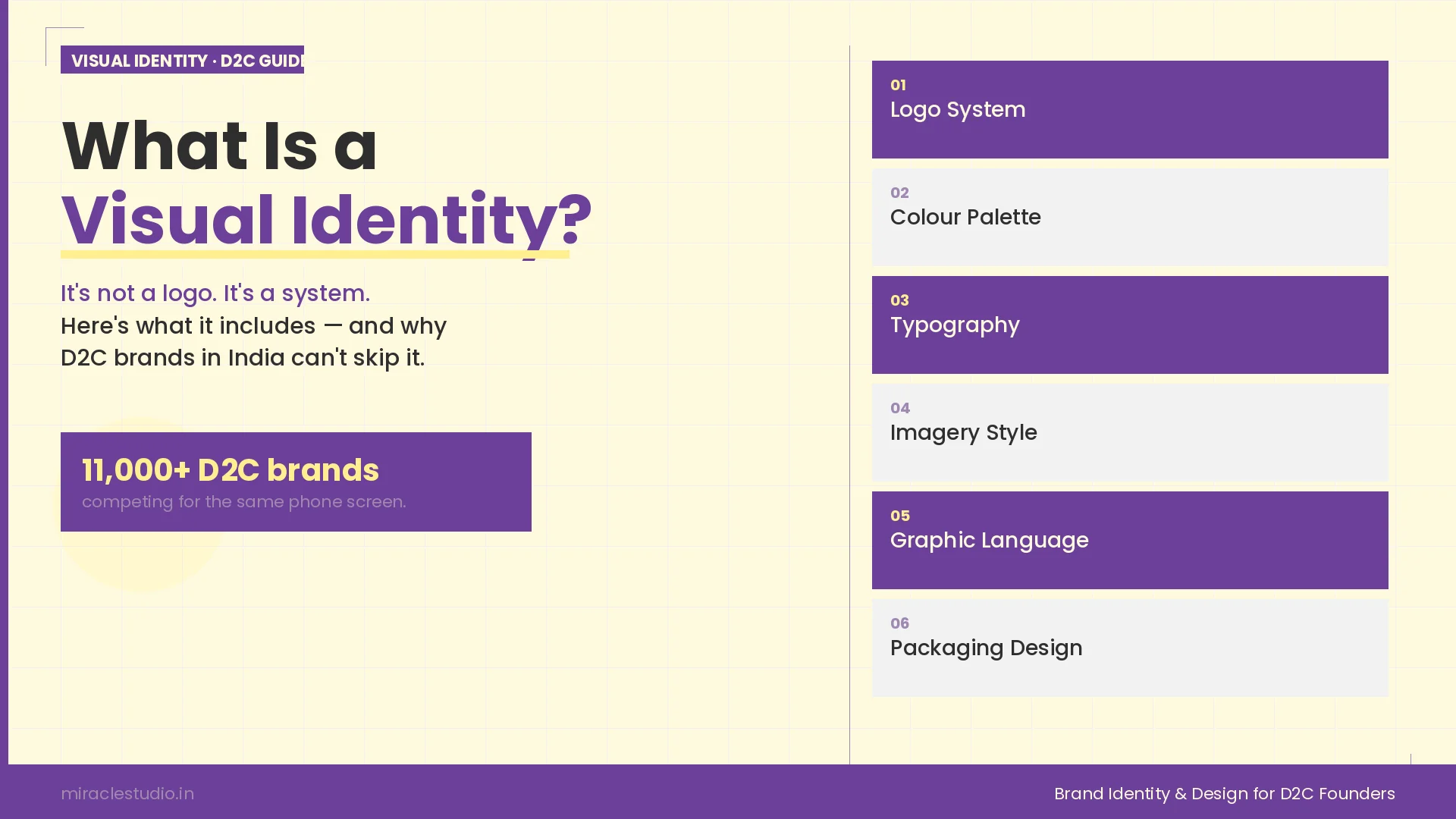
TL;DR: A visual identity is not a logo. It’s the complete system of visual elements - colour, type, imagery, layout, packaging - that makes your brand instantly recognisable across every touchpoint. For D2C brands in India, where the first impression happens on a phone screen and the competition is 11,000 brands deep, getting this right is not optional. This guide breaks down exactly what a visual identity system includes, why it matters more for D2C than any other business model, and how to build one that scales.
Introduction
Most D2C founders get a logo made and call it a brand.
Six months later, the Instagram grid looks different from the packaging, the packaging looks different from the website, and the Meta ads look like they belong to a different company entirely. Nobody can quite put their finger on why the brand doesn’t feel premium - but it never converts the way it should.
This is a visual identity problem. And it’s one of the most expensive mistakes a D2C brand can make, because by the time it becomes obvious, you’ve already built the wrong foundation.
India’s D2C market is expected to reach $322 billion by 2031. Visual identity has become a critical differentiator in the D2C playbook - packaging and design are increasingly treated as strategic assets that enhance the customer experience and encourage organic sharing on social platforms. In a market this competitive, a brand that looks inconsistent doesn’t just underperform. It disappears.
This guide is for D2C founders who want to understand what a visual identity system actually is, what it includes, and how to build one that works across every surface your brand appears on.
What Is a Visual Identity?
A visual identity is the complete set of visual elements that represent your brand - how it looks, feels, and communicates across every touchpoint, from your logo to your packaging to your Instagram Stories.
It’s not just a logo. A logo is one component of a visual identity, the same way a headline is one component of a piece of writing. The logo matters, but it’s the system around it that determines whether your brand builds recognition or stays forgettable.
A complete visual identity includes:
A logo system (primary, secondary, and icon variants)
A colour palette (primary, accent, and neutral tones)
A typography system (headline, body, and accent fonts)
An imagery and photography style
Graphic elements and design language
Packaging design
Motion and animation guidelines (increasingly important for digital-first brands)
A social media visual framework
Each of these elements, used consistently and intentionally, creates the cumulative visual impression that customers recognise as your brand - even before they consciously register the logo.
Think of the brands you recognise instantly. You know a Minimalist product before you see the name. You know a Sugar Cosmetics ad before you read the copy. That’s not luck. That’s a visual identity system doing its job.
Why Visual Identity Matters More for D2C Than Any Other Business Model
In traditional retail, physical shelf presence does some of the brand recognition work. A customer sees your product repeatedly, in a familiar context, next to familiar competitors. The shelf builds familiarity passively.
In D2C, there is no shelf.
Your brand appears on a 6-inch phone screen, in a 3-second scroll, competing with hundreds of other brands for the same fraction of attention. It appears in a Blinkit thumbnail at 80×80 pixels. It appears in an unboxing video on Instagram Reels. It appears on your Shopify store, on your packaging insert, on the WhatsApp message you send after delivery.
Every one of these appearances is an opportunity to build recognition - or to confuse.
For D2C brands, social media influences not only how products are marketed but also how they are designed, packaged, and positioned, giving rise to products built to perform visually in digital environments. This means your visual identity isn’t just brand infrastructure - it’s product design. It’s performance marketing creative. It’s retention strategy.
The brands that understand this build visual systems from day one. The ones that don’t spend years and budgets trying to retrofit coherence onto a brand that was never designed to be consistent.
This is exactly what we help D2C founders avoid at Miracle Studio - not just making things look good, but building the visual infrastructure that makes every downstream decision faster and cheaper. Book a free 30-minute discovery call if you’re at the start of this process.
The 6 Core Elements of a D2C Visual Identity System
1. Logo System - Not One Logo, But a Family
Most founders think of a logo as a single file. A logo system is a family of marks designed to work across every context your brand appears in.
A complete D2C logo system includes:
Primary mark: The full logo - wordmark, symbol, and any tagline - used when space and context allow.
Secondary mark: A horizontal or stacked variant for different layout orientations. A skincare brand’s primary logo might be vertical for packaging; the horizontal variant works on website headers.
Icon or symbol mark: A simplified version - the standalone symbol or first letter - used at small sizes where the full logo becomes illegible. This is what appears on your app icon, your favicon, your quick commerce thumbnail.
Monochrome variants: Your logo needs to work in white (for dark backgrounds), black (for light backgrounds), and single-colour formats for embossing, embroidery, or single-ink packaging.
Building all of these from the start means you never have to improvise at a deadline. Your designer has clear assets. Your packaging team has clear specs. Your ad agency has clear files. The logo system is the foundation everything else sits on.
2. Colour Palette - The Fastest Brand Recognition Tool
Colour is the most immediate visual signal a brand has. Before a customer reads your name or processes your logo, they’ve already registered your colours. For D2C brands competing in crowded digital feeds, colour recognition is often the difference between a scroll and a stop.
A well-designed D2C colour palette has three tiers:
Primary colours: The one or two colours most associated with your brand. These appear on everything - packaging, website, ads, social media. They’re your brand’s visual signature.
Secondary/accent colours: Supporting colours that add depth and flexibility. Used for contrast, highlights, CTAs, and graphic elements without overwhelming the primary palette.
Neutral tones: Whites, creams, greys, or blacks that provide breathing room. These are often undervalued but critical - they’re what make the primary and accent colours feel intentional rather than chaotic.
The key constraint: every colour in the palette must work together, and the palette must work across both digital screens (RGB) and print/packaging (CMYK). A colour that looks perfect on your monitor can print muddy on a kraft box. Get your hex codes, RGB values, and CMYK values documented before a single piece of packaging goes to print.
Colour also carries cultural weight in India that global branding frameworks often miss. Red signals celebration and auspiciousness in most Indian contexts. White can signal mourning. Saffron and green carry religious significance. None of this means you should avoid these colours - but it means understanding the full range of associations before committing to a palette.
3. Typography - The Voice of Your Visual Identity
Typography is the element most founders underestimate and most designers notice first. The typefaces your brand uses communicate personality, authority, and positioning before anyone reads a word.
A D2C typography system typically needs three levels:
Display or headline typeface: Used for large, attention-grabbing text - brand headlines, packaging hero text, campaign titles. This font carries the most personality and does the most emotional work.
Body typeface: Used for longer-form content - product descriptions, website copy, email newsletters. Needs to be highly legible at small sizes across digital screens.
Accent or detail typeface (optional): A third typeface used sparingly for labels, captions, or decorative elements. Creates visual variety without breaking coherence.
The practical rules: choose no more than two or three typefaces. Ensure they’re readable at every size you’ll use them. Make sure they’re licensed for all the uses you need - web, print, social - because commercial font licensing is specific and violations are expensive.
And commit. One of the fastest ways to make a brand look cheap is to use different fonts across different touchpoints because someone didn’t have the brand guidelines in front of them. Typography consistency is brand consistency.
4. Imagery and Photography Style - The Emotional Layer
Product photos convert. But the photography style - the lighting, the mood, the setting, the subjects - communicates something deeper than any product description can.
For D2C brands, imagery style typically spans two categories:
Product photography: How your product looks in isolation - on white, on textured surfaces, in flatlay arrangements. This is the workhorse imagery for product pages, marketplace listings, and quick commerce thumbnails. It needs to be clean, consistent, and shot to work at multiple sizes.
Lifestyle or editorial photography: How your product exists in the world - in use, in context, with people. This imagery builds emotional connection and aspiration. It’s the content that earns saves and shares on social media.
Both styles need to be defined and documented before you scale. If your product photography is warm and textured but your lifestyle photography is cool and clinical, the brand looks like two different companies. A simple photography style guide - specifying background colours, lighting direction, model demographic, colour grading - ensures consistency whether your photographer is in Mumbai or Faridabad.
5. Graphic Language and Design Elements
Beyond the logo and colour, strong visual identities have a visual vocabulary - a set of shapes, patterns, lines, or graphic devices that appear consistently across brand communications.
This might be geometric shapes used as framing devices. It might be a specific line weight used for borders and dividers. It might be a watermark pattern used on packaging and on social media backgrounds. It might be annotation-style labels that become a signature of your brand’s aesthetic.
These elements do two things. First, they give your designers a toolkit that makes every new piece of content faster to produce and more coherent with everything else. Second, they create the kind of visual richness that makes a brand feel considered rather than assembled.
The Whole Truth is a strong example of graphic language done deliberately. The Whole Truth deliberately reversed traditional packaging patterns - most food brands hide problematic ingredients in fine print, while TWT lists all ingredients on the front panel using large, bold fonts. This commitment to transparency extends throughout their visual identity, incorporating mark-ups, annotations, and their unofficial mascot Barry who serves as the voice of “truthful packaging.” The graphic language isn’t decorative - it’s the brand belief expressed visually.
6. Packaging Design - The Physical Brand Moment
For D2C brands selling physical products, packaging is the most important touchpoint in the entire customer journey. It’s the first physical interaction a customer has with your brand after a digital purchase - and it determines whether they photograph it, share it, and come back.
Strong D2C packaging needs to solve for three contexts simultaneously:
Digital discovery: How does this pack look as a thumbnail on Blinkit, Zepto, or Amazon? At 80×80 pixels, complex designs lose detail and cluttered labels become unreadable. The brand needs to be recognisable at thumbnail scale.
Physical delivery: How does this pack hold up through a last-mile delivery? Material choice, seal quality, and structural integrity all affect the first impression when the box arrives.
Unboxing experience: What does the customer encounter when they open it? The inside of a box, the tissue, the insert card, the thank-you note - all of these are brand touchpoints. Brands that invest here earn organic social content that costs nothing.
Packaging is also the signal investors and retail partners use to judge a brand’s seriousness. A well-designed pack communicates professionalism before any pitch deck does.
What a Visual Identity Is Not
Clarity on what to build requires equal clarity on what to avoid.
A visual identity is not a mood board. A mood board is research. It shows you what you’re inspired by. A visual identity is the system built from that inspiration - specific, documented, and deployable.
A visual identity is not a Canva template. Templates give you flexibility without coherence. A real visual identity gives your team constraints that produce consistency, not a blank canvas that produces chaos.
A visual identity is not finished at launch. Strong visual identities evolve - but they evolve with intention, not with every trend cycle or designer preference. The system should be stable enough to build recognition over years, and flexible enough to adapt to new formats and channels as they emerge.
A visual identity is not just for big brands. This is the mistake that costs early-stage D2C founders the most. Waiting until “we’ve grown a bit” to invest in a proper visual identity means spending years building brand recognition on the wrong foundation - then having to dismantle and rebuild it at scale, at far greater cost.
How Do You Know If Your Visual Identity Is Working?
Three signals.
Recognition without the logo. Show someone a piece of your brand collateral - an Instagram Story, a packaging closeup, an email header - with the logo removed. Do they recognise the brand? If not, your visual identity isn’t doing its job.
Consistency without effort. Can a new team member, a freelance designer, or a new agency produce on-brand work without extensive briefing? If every new piece of content requires a round of revisions to feel right, the system isn’t documented well enough.
Differentiation in the feed. Put your brand’s content next to three of your competitors in the same feed. Does yours stand out? Does it feel distinctly yours? If it could belong to anyone in the category, the visual identity hasn’t done enough strategic work.
How Much Does a Visual Identity System Cost in India?
The honest answer: it varies significantly, and cheap visual identity work is one of the most expensive mistakes a D2C brand can make.
A freelancer-produced logo might cost ₹5,000–₹25,000. It gives you a file, not a system. No usage documentation, no variants, no colour specifications for print, no typography guidance. Every subsequent design decision has to be made from scratch.
A professional brand identity project with a design agency - covering positioning, logo system, colour palette, typography, photography direction, packaging design, and brand guidelines - typically starts from ₹1.5–5 lakh depending on scope. For D2C brands planning to scale, this investment pays back through faster content production, lower revision costs, stronger first impressions, and visual coherence that builds brand equity over time.
The question isn’t whether you can afford to invest in a proper visual identity. It’s whether you can afford to scale without one.
Conclusion
A visual identity system is the infrastructure your D2C brand runs on. It determines how quickly customers recognise you, how consistently your brand communicates across every touchpoint, and how premium you’re perceived to be - before they’ve read a word of your copy or experienced your product.
For D2C founders in India, where the market is growing fast and the competition is growing faster, a strong visual identity isn’t a nice-to-have. It’s the foundation that makes every other investment - in ads, in content, in product - more effective.
If you’re building a D2C brand and want to get the visual identity right from the start, book a free 30-minute discovery call with Miracle Studio. We’ll help you understand exactly what your brand needs - and how to build it in a way that scales.