You got a logo made. Picked your brand colours. Maybe even chose a font. Then you launched your Shopify store, started running Meta ads, hired a freelancer for social media, and outsourced your packaging design to someone on Fiverr.
Now your Instagram looks nothing like your website. Your packaging clashes with your ad creatives. Every new designer you bring on asks the same question: "Do you have brand guidelines?"
The problem isn't your logo. The problem is you never built a D2C brand design system around it.
Most founders treat branding as a one-time deliverable — a logo file and a colour palette — then move on to growth. But as your brand scales across channels, freelancers, and touchpoints, that logo can't hold everything together on its own. What holds it together is a system.
This is the difference between a brand that looks professional and one that actually sells. And in India's D2C market — where hundreds of new brands launch every month and consumer attention is ruthlessly competitive — that difference decides who scales and who stalls.
At Miracle Studio, we build these identity systems for D2C brands across India — and the pattern we see is almost always the same. The founder invested in a logo. Skipped the system. And now they're paying for it in inconsistency, wasted design cycles, and eroding brand trust.
What Is a D2C Brand Design System (And What It Isn't)?
A design system is not a PDF of brand guidelines that sits in a Google Drive folder and never gets opened. It's the operational rulebook that ensures every touchpoint — packaging, website, ads, social media, email — feels like it belongs to the same brand. Without you micromanaging every pixel.
Think of it as three layers:
Logo is a mark. It identifies you. That's all it does.
Brand identity is the visual language — your colours, fonts, imagery style, and how they work together. It's what most founders think of when they say "branding."
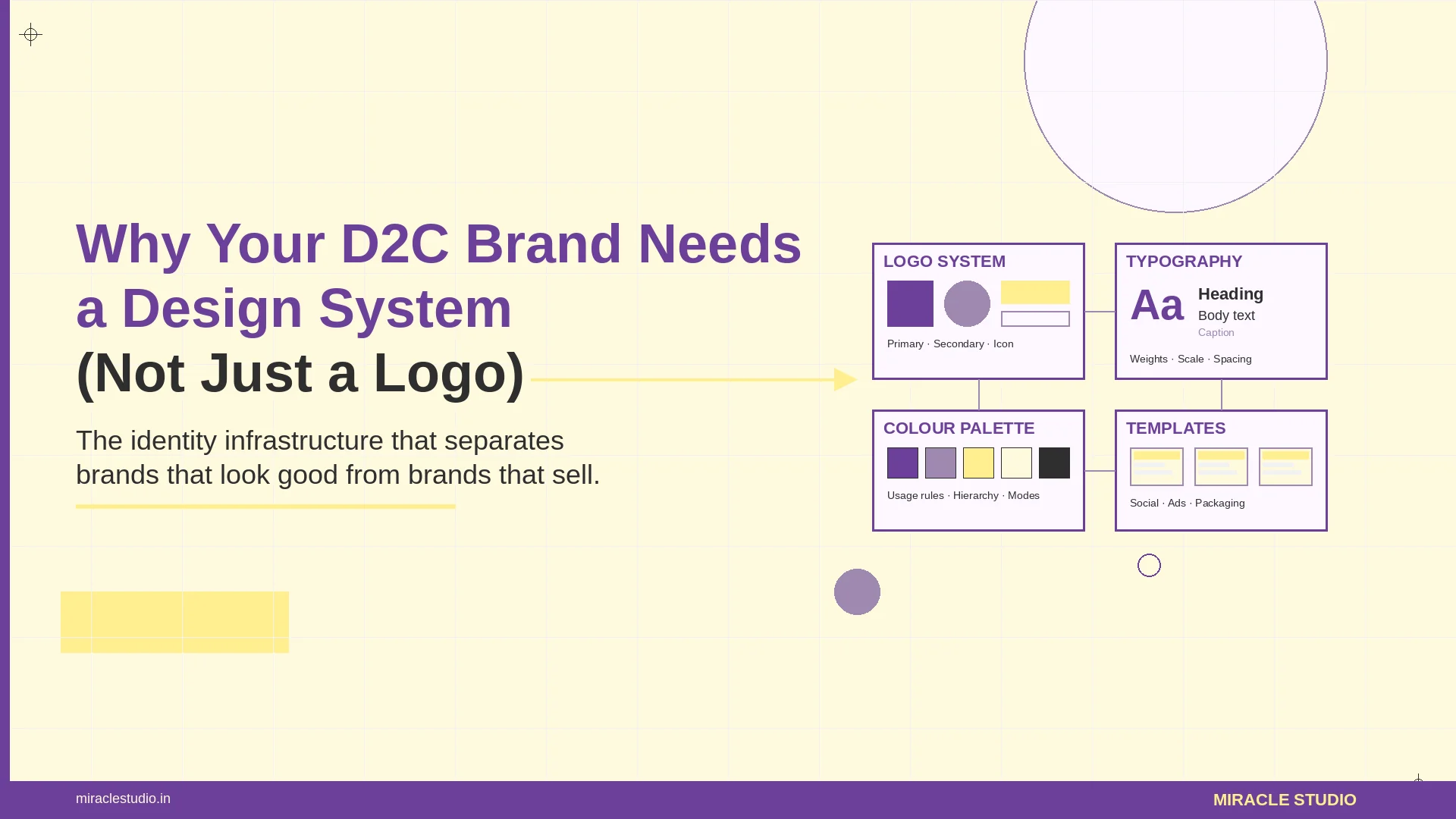
Design system is the infrastructure. It codifies how your identity gets applied across every channel, by every person who touches your brand. It includes usage rules, spacing guidelines, template frameworks, tone of voice, and creative guardrails that make execution consistent at scale.
These are layers, not synonyms. A logo is not an identity. An identity is not a system. And most D2C brands stop at layer one or two — then wonder why their brand feels fragmented.
If you're still unclear on where the line falls between identity and image, this breakdown of brand identity versus brand image is worth reading.
The Logo Trap: Why Most D2C Founders Stop Too Early
Here's the pattern. Founder gets a logo. Picks a colour palette from Coolors. Chooses a Google Font that "feels right." Launches the store. Moves on to customer acquisition.
For the first few months, it works. The founder is approving every creative personally. The brand stays somewhat coherent because one person is gatekeeping everything.
Then scale happens. You hire a social media manager. A performance marketing freelancer. A packaging vendor. A Shopify developer. Each one interprets your "brand" differently — because there's nothing beyond a logo file and a vague colour code to guide them.
The result: your feed looks like five different brands made it. Your unboxing experience contradicts your website's premium feel. Your ad creatives cycle through random visual styles that confuse more than they convert.
Research consistently shows that consistent brand presentation across all platforms can increase revenue by up to 23%. The inverse is equally true — inconsistent brands often need to spend significantly more on advertising just to achieve the same level of recognition.
And this isn't just a visual problem. It's a trust problem. When a customer sees your polished Instagram ad, clicks through to a website that feels different, and then receives packaging that tells yet another story — they don't think "this brand is still figuring things out." They think "this brand isn't what it claimed to be." In a D2C market where customer acquisition costs have risen sharply since 2021, you can't afford to lose trust at the last mile because your touchpoints don't match.
This is the trap. The logo got you started. But without a system, it becomes the ceiling — not the foundation. If you've been through a rebrand attempt that didn't stick, the patterns behind failed DIY rebrands will sound familiar.
How Do You Know If Your D2C Brand Needs a Design System?
If you're scaling a D2C brand in India and any of the following sound familiar, the answer is yes — you need one.
Your social media feed looks like five different brands made it. Every post has a different layout, colour treatment, or typography style. There's no visual thread tying it all together. Followers can't recognise your content in their feed without reading the handle.
Every new freelancer or agency asks for brand guidelines — and you don't have them. You end up screen-sharing old Canva files or forwarding WhatsApp messages with hex codes. Onboarding takes longer than it should. The first round of work always misses the mark.
Your packaging and website feel like they belong to different companies. The unboxing experience tells one story. The product page tells another. A customer who discovered you through an ad, then visited your site, then received the package — they experienced three different brands.
You're personally approving every creative because no one "gets" the brand. This is the biggest red flag. If you're the single point of failure for brand consistency, you don't have a system. You have a bottleneck.
Your ad performance is declining despite solid targeting. Creative inconsistency erodes trust faster than most founders realise. When your ad doesn't look like your landing page, which doesn't look like your checkout confirmation email, the conversion funnel leaks at every seam.
This is the kind of identity infrastructure we build at Miracle Studio — systems that let your brand scale without your taste being the only quality control. See how we approach it →
What Actually Goes Into a Design System for D2C Brands?
A design system for a D2C brand isn't a 200-page document built for a Fortune 500 company. It's a focused, practical toolkit that any designer, freelancer, or agency can pick up and execute from — without guessing.
Here's what it typically includes:
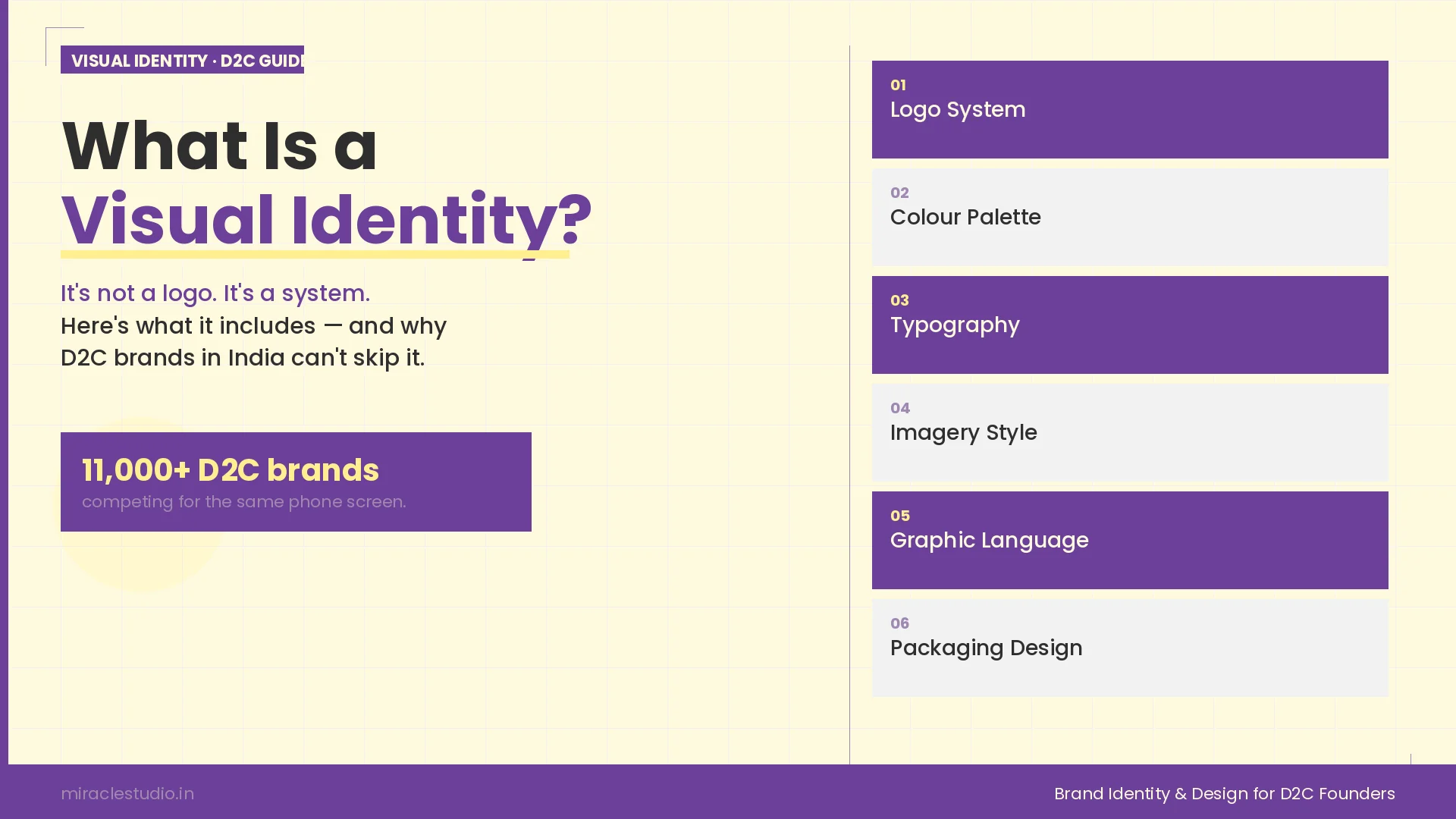
Logo system. Not just one logo file. A primary lockup, a secondary version, a favicon, a social media avatar, and clear rules for when to use which. Minimum size, clear space, and what never to do with it.
Colour palette with usage rules. Not just five hex codes. Which colour is dominant, which is accent, which is reserved for CTAs. How the palette adapts for dark backgrounds, packaging, and digital screens. Consistent colour usage alone can improve brand recognition by up to 80%.
Typography hierarchy. Heading fonts, body fonts, sizes, weights, and line spacing. What goes on packaging versus what goes on the website versus what goes in an Instagram Story. A clear type system is one of the essential elements of a timeless visual identity.
Photography and imagery style. Are your product shots lifestyle or studio? Warm-toned or neutral? Do you use illustrations? What's the visual mood? Without this, every photographer and editor produces something different.
Packaging grid system. How information is arranged on your boxes, pouches, or labels. Where the logo sits, where the legal copy goes, how the hierarchy flows. This is especially critical for D2C brands selling across platforms where the unboxing is a brand moment.
Social media and ad creative templates. Frameworks — not rigid templates — that give your team a starting point for every post, Story, or ad. A system of layouts, text placement zones, and colour applications that maintain brand feel while allowing creative flexibility.
Tone of voice guidelines. How your brand sounds in captions, emails, product descriptions, and customer support. This is the layer most D2C brands skip — and it shows. Building this blueprint for consistency is what separates brands that feel intentional from those that feel improvised.
The point isn't rigidity. It's giving everyone who touches your brand the same playbook — so the output is cohesive whether it's you, a freelancer in Bangalore, or an agency in Mumbai executing it.
What's the Real ROI of a D2C Brand Design System?
The return isn't abstract. It compounds across every function of your business.
Faster creative production. When designers have a system to work from, they don't spend hours interpreting your brand from scratch. Turnaround times drop. Revision cycles shrink. You stop being the bottleneck.
Lower design costs. A well-documented system means any competent designer can execute on-brand work. You're not locked into one expensive agency because they're the only ones who "know" your brand.
Stronger brand recall. Studies indicate that brands maintaining consistent visual identity see significantly better recognition among consumers. For D2C brands competing in crowded categories — skincare, fashion, food — recognition is the first filter. If they don't recognise you, they don't click.
Higher conversion across touchpoints. Trust compounds. When your ad looks like your landing page, which looks like your checkout email, which matches the packaging that arrives — every step reinforces the purchase decision. Inconsistency, on the other hand, introduces friction at every transition. And in a market where nearly a third of customers will walk away from a brand after just one bad experience, that friction isn't trivial.
Brand equity that survives beyond paid campaigns. This is the one most D2C founders underestimate. Paid ads get you in front of people. But when the ad spend stops, what remains? A design system builds the kind of brand equity that generates organic word-of-mouth, repeat purchases, and referral behaviour. The brands that survive rising CAC are the ones customers remember without a retargeting pixel reminding them.
Indian D2C brands that invest in cohesive brand infrastructure early — before the ₹1 crore revenue mark — consistently outpace those that try to bolt on brand systems after scaling. The longer you wait, the more visual debt accumulates, and the more expensive the cleanup becomes. Every mismatched creative, every off-brand freelancer deliverable, every packaging run that doesn't align — it all compounds into a brand that feels amateur at scale.
The brands winning in India right now — the ones building real equity, not just running ads — understand that how D2C brands scale with consistent design systems is a function of infrastructure, not inspiration.
The Logo Got You Started. The System Gets You to Scale.
A logo is a necessary starting point. But it was never meant to carry your entire brand across ten channels, fifteen freelancers, and a hundred thousand customer touchpoints.
If your brand feels inconsistent across platforms — if every new collaborator produces something that doesn't quite feel like you — it's not a creative problem. It's a systems problem. And systems can be built.
Three things to take away:
A logo identifies. A design system operationalises. Confusing the two is the most expensive branding mistake D2C founders make.
Consistency isn't about being rigid — it's about being recognisable. And recognition is what converts attention into trust, and trust into revenue.
The earlier you build the system, the less it costs and the more it compounds. Every month you delay is another month of visual debt — off-brand creatives, mismatched packaging, onboarding friction with every new hire or vendor.
At Miracle Studio, we design brand identity systems for D2C brands across India — the kind that travel cleanly from Shopify storefront to Instagram feed to the box on someone's doorstep. If your brand has outgrown its logo, let's talk.