Let’s dispense with the pleasantries. If you are a D2C founder or an agency owner managing a significant spend, you already know the era of easy arbitrage is dead. The algorithm is no longer your media buyer; the algorithm is your creative strategist.
For years, the industry obsessed over targeting structures, bid caps, and lookalike audiences. Today, Meta and TikTok have flattened the technical curve. The targeting is the creative. Yet, despite this shift, most brands treat ad creative as an aesthetic exercise rather than a mathematical variable.
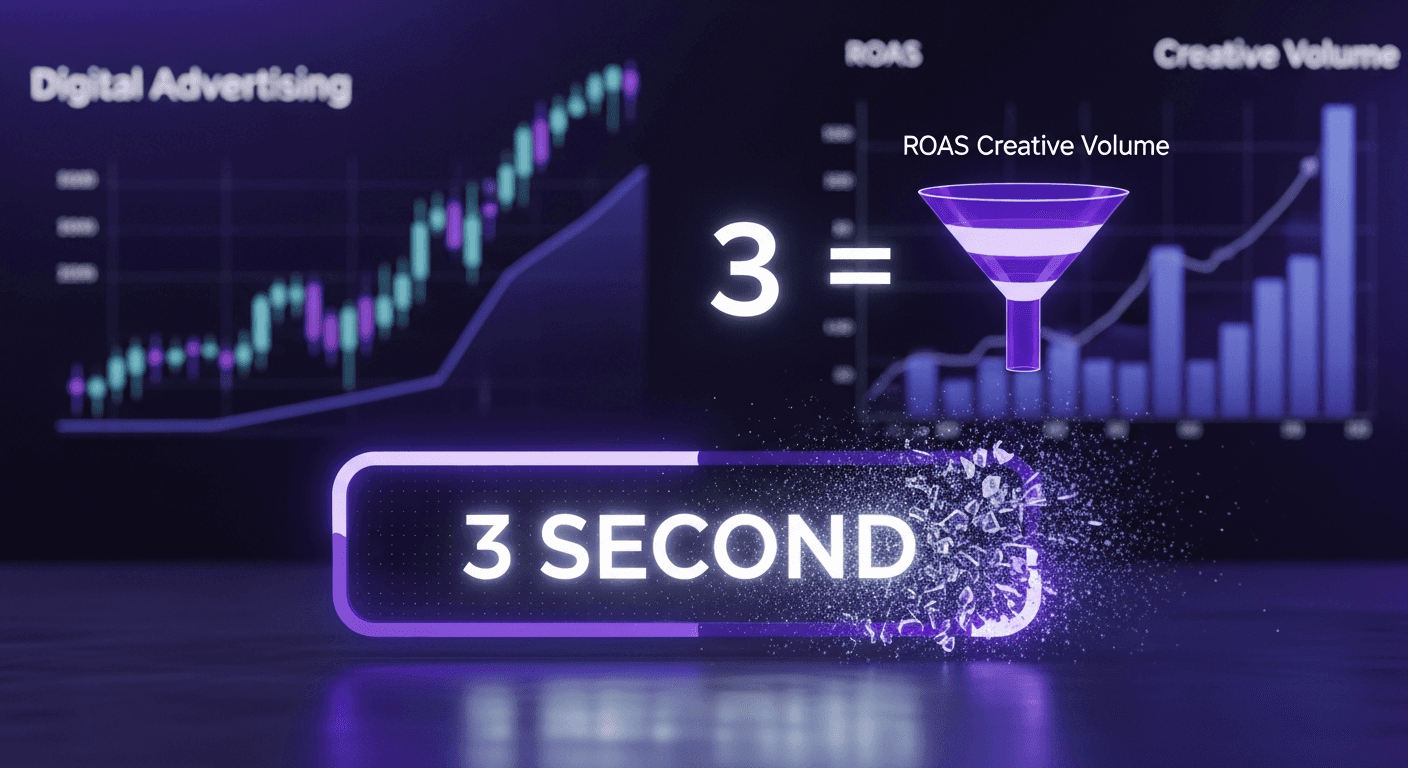
If your Cost Per Acquisition (CPA) is climbing and your Return on Ad Spend (ROAS) is plummeting, the problem likely isn't your landing page—it’s the first three seconds of your video. This is the mathematics of Hook Rate. If you cannot stop the scroll, you cannot sell the product. Here is the data-driven reality of why your ads are failing and how to engineer a creative pipeline that converts.
1. The 3-Second Cliff: Calculating the Cost of Apathy
Attention is the most volatile currency in the digital economy. The average user scrolls through 300 feet of content daily. To interrupt that inertia requires more than just ‘good design’; it requires a calculated disruption.
The metric you must obsess over is Hook Rate (3-Second Video Plays / Impressions). Benchmarks vary by industry, but if your Hook Rate is below 25-30% on TikTok or Reels, you are essentially lighting money on fire. You are paying for impressions that never transform into consideration.
The Downstream Impact on ROAS
There is a direct correlation between Hook Rate and Conversion Rate. A low Hook Rate signals to the algorithm that your content is irrelevant, raising your CPMs (Cost Per Mille). Conversely, a high Hook Rate lowers your CPM, giving you cheaper traffic.
If you don't understand the geometry of attention, you are flying blind. As we discussed in our analysis of Math in Design, numbers don't just measure results; they dictate the structure of the visual itself. The Golden Ratio isn't just for logos; it applies to the framing of your opening shot.
2. Visual Mechanics: What Actually Stops the Scroll?
High-performing hooks aren't accidents. They are engineered using specific psychological triggers. If your creative team is prioritizing ‘brand aesthetics’ over ‘pattern interrupts,’ they are failing you. While brand consistency is vital, performance creative requires a different set of rules.
Contrast and Typography
The first frame must be visually jarring. This doesn't mean ugly; it means high contrast. One of the most overlooked levers is typography. The font you choose for your overlay text communicates urgency, luxury, or utility before the user reads a single word.
Using generic sans-serifs blends into the UI of the platform. You need distinctiveness. We recently broke down the 13 best font combinations serious brands swear by. Applying these principles to your video overlays adds a layer of authority that subconsciously forces the user to pause. A bold, serif headline on a chaotic background creates the cognitive dissonance required to arrest attention.
The "Ugly Ad" Paradox
Refined, polished studio shots often perform worse than raw, user-generated content (UGC) or lo-fi motion graphics. Why? Because high polish looks like an ad. Your audience has developed ‘banner blindness’ for anything that smells like a commercial. The goal is native integration. You want your ad to look like organic content until the value proposition hooks them.
3. The Velocity Problem: Why You Are Losing to Competitors
Here is the brutal truth about performance marketing in 2024: Creative fatigue sets in faster than ever before.
A winning creative asset used to last three months. Now, you are lucky if it maintains efficiency for three weeks. As you scale spend, you accelerate fatigue. To maintain a healthy ROAS, you need to test new creatives constantly. This is a volume game.
Most agencies and in-house teams operate on a 10-14 day turnaround time for new creative assets. This is lethal. By the time you receive the new variation, the market sentiment has shifted, or a competitor has already saturated the angle.
The 28-Hour Advantage
Speed is your primary hedge against rising CAC. This is exactly why we engineered Miracle Studio's 28-hour turnaround model. We recognized that D2C founders cannot wait two weeks to find out an angle doesn't work.
You need to be launching 5-10 new creative variations weekly. This allows you to kill the losers quickly and scale the winners aggressively. If your design pipeline is clogged, your ad account is stagnant. The math is simple: More shots on goal equals more goals.
4. Balancing Brand Equity with Performance Aggression
A common objection from founders is that performance creative cheapens the brand. This is a false dichotomy. You do not have to choose between high conversion and brand integrity. You simply need to understand the difference between your Brand Identity and your Campaign Assets.
Your brand guidelines are the constitution, but your ads are the amendments. We’ve explored this nuance in our guide on Brand Guidelines vs. Brand Identity. Your ad creative can be aggressive, native, and raw while still utilizing your core color palette and tone of voice.
Learning from the Giants
Look at Zomato. They are masterclass marketers who balance performance with strong identity. In our breakdown of Zomato’s rebranding, we saw how a brand can evolve its visual language to stay relevant without losing its core DNA. They use humor, bold typography, and minimalist visuals to hook users instantly.
Furthermore, staying ahead of visual trends is critical. What worked in 2023 looks dated today. Review the branding design trends for 2025-2026 to ensure your hooks aren't just stopping the scroll, but signaling that your brand is a modern leader.
5. The Feedback Loop: From Data to Design
The final variable in the equation is the feedback loop. Creative strategists and media buyers must live in the same dashboard. Design decisions should not be made in a vacuum; they must be answers to specific questions.
Before briefing your next batch of ads, ask the right questions. We compiled 94 questions about graphic design that can help clarify your intent. For performance ads, narrow it down to:
What is the drop-off rate at the 3-second mark?
Does the text overlay match the winning keywords from our search campaigns?
Is the visual hook relevant to the problem we are solving?
Iterative Testing Framework
The Variable Test: Change only the first 3 seconds (the Hook) while keeping the body of the video identical. Run 5 variations.
The Body Test: Take the winning Hook and pair it with 3 different value propositions (Problem/Solution, Social Proof, Usability).
The CTA Test: Test different closing offers (Discount vs. Bundle vs. Guarantee).
This systematic approach removes the ego from the creative process. The data decides what is “good design.”
Conclusion: Adapt or Decay
The mathematics of Hook Rate are unforgiving. A 3-second delay in capturing attention is a death sentence for your ROAS. You cannot afford to be precious about your creative. You need to be prolific.
You need a partner who understands that design is a function of business, not just art. You need velocity. You need to move faster than the fatigue curve.